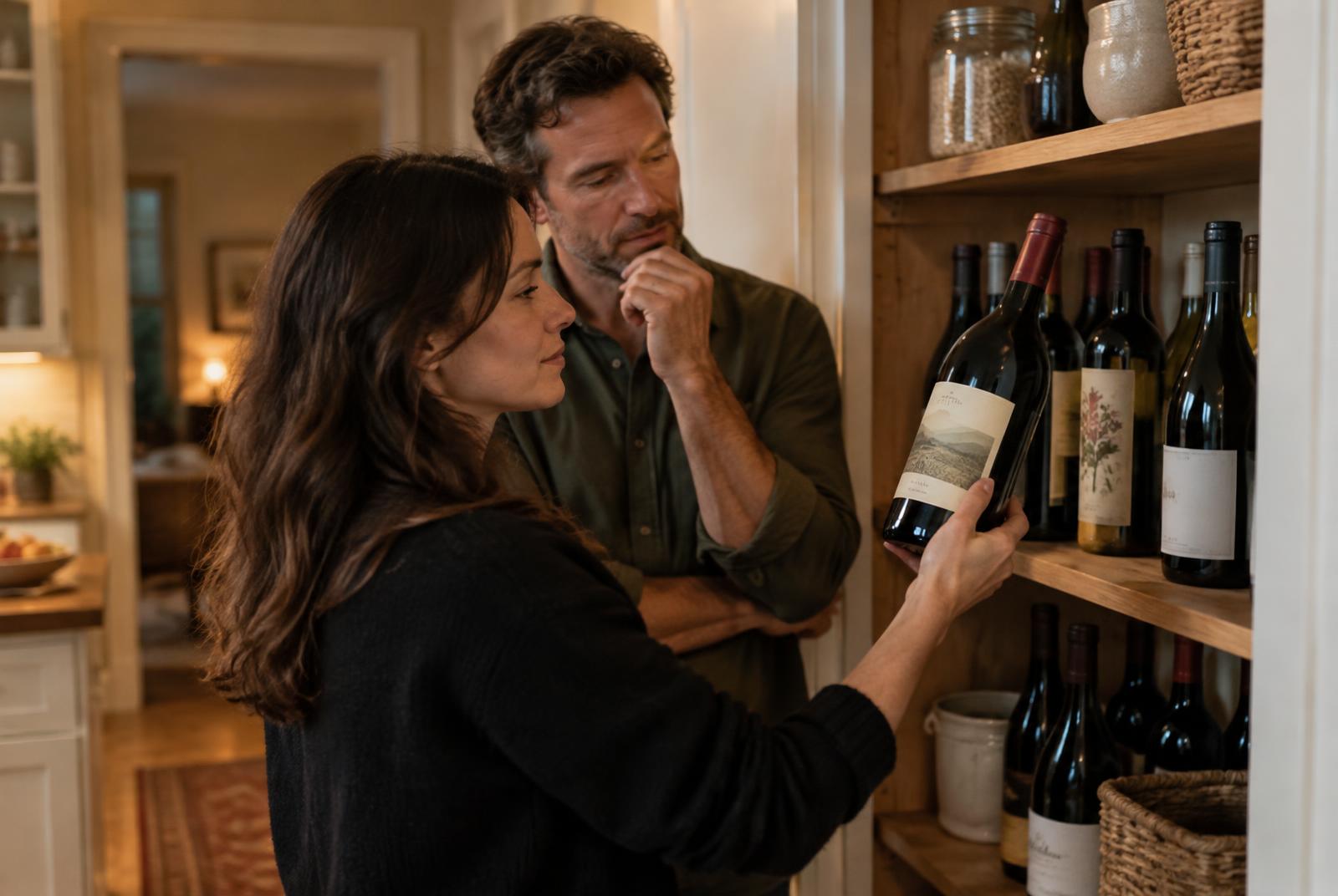
We are due at a friend's house in half an hour, and my wife and I are standing in front of the open pantry, looking at a bottle of red on the second shelf. It seems like the right thing to bring. She lifts it out, wipes the dust off the shoulder with her thumb, and asks where we got it. I turn the bottle around and read the back label, as if the answer might be printed there. Neither of us can say whether we bought it or whether it was a gift, and if it was a gift, neither of us can say who gave it to us. That matters tonight, because there is a fair chance it came from the people whose door we are about to knock on.
The other questions arrive right behind that one. We cannot remember what we paid for it, so we do not know whether we are about to hand over a $16 bottle or a $65 one. We agree to stop at a Binny's since it's on the way.
The ordinary problem behind a simple wine tracking app
Corkboard started with that very ordinary problem. My wife and I enjoy wine, but neither of us has the time or the desire to become a wine expert. We would find a bottle we liked, buy another one occasionally, receive one as a gift, or put a few bottles away for later. Then, months later, we would find ourselves asking the same questions. Did we like this one? Where did we get it? How much did we pay? Was this the bottle someone gave us? And, most practically, where did we put the other bottle?
What I noticed is that none of those questions are about the wine itself. They are about our own history with it. We didn't need a better way to rate wine, we needed a better way to remember it.
Most wine apps solve a bigger problem
There are certainly a number of exceptional wine apps available. You can catalog a cellar, record detailed tasting notes, track vintages, research regions, assign scores, follow drinking windows, and compare what you think with what other wine drinkers think. For someone building a serious wine collection, the existing apps do it very well, but it was not what we needed.
We wanted something closer to a personal wine journal, except even "journal" made it sound like more work than we had in mind. The goal was simple: take a picture of a bottle and remember the few things about it that would matter later. If you recognize yourself in the pantry scene, I would suggest starting from the same place. Decide what you will want to know six months from now, and let that set how much you record.
The four things we kept wanting to remember
After thinking about how we bought and drank wine, the information we cared about came down to a short list of four things.
The first is where we got it. Maybe it came from a wine shop we liked, a restaurant, a trip, or a friend. Knowing the source can be more useful than knowing an expert's score, because the source tells you how to find the bottle again. When the bottle was a gift, it also tells you who to thank and who not to hand it back to.
The second is what we paid. A $16 bottle you enjoyed and a $65 bottle you enjoyed are not the same purchasing decision the next time around. One is a wine you can pick up on any weeknight, and the other is one you save for an occasion. The price also tells you which bottle is right to bring to someone's house, which is the question we couldn't answer in the pantry.
The third is whether we liked it. I don't mean 91 points versus 93 points, or an analysis of acidity, tannins, and finish. I mean one question: would we drink it/buy it again? For us, that was the question that mattered, and it is the one I would recommend recording even if you record nothing else.
The fourth is where we put it. Once you have more than a handful of bottles, this becomes important sooner than you would expect. Ours end up on the kitchen rack, downstairs, in the refrigerator, or in a box somewhere that seemed like a perfectly sensible storage location six months ago. Those four things became the basic idea behind Corkboard.
Take a photo of the wine label and let the app do the rest
Manually entering every detail from a wine bottle would defeat the purpose, so Corkboard starts with the label. Take a photo, and AI identifies the wine and creates a record for it. You can then add the information that matters to you: where it came from, what you paid, whether you liked it, and where the bottle is stored. The label scan handles the part that is tedious to type, and you supply the part only you know.
Over time, instead of accumulating hundreds of wine label photos in your camera roll, you build something more useful: a searchable memory of the wines that have passed through your life. That is how I think about Corkboard. It's not only a wine inventory app or a wine cellar tracker. It's simply a memory system for wine.
A wine app for casual wine drinkers
Wine has a peculiar ability to make simple things sound complicated. There is an enormous amount to learn about grapes, producers, regions, vintages, winemaking techniques, food pairings, and tasting. For people who want to explore that world deeply, there has never been more information available. There are also a lot of us who simply enjoy wine. We know what we like when we drink it, and we are not particularly good at remembering the bottle six months later.
Corkboard is for that person. You shouldn't need to know wine terminology to keep a wine journal. You should not have to build a formal cellar database to remember what is downstairs. And you shouldn't have to rate a wine against everyone else's tastes when the opinion that decides what you buy next should be your own.
Why Corkboard is free
Corkboard began as a small project to solve our own problem. As it grew, it became obvious that we were not the only people with that problem. There are plenty of casual wine drinkers whose current wine tracking system consists of label photos, notes on their phones, receipts, spreadsheets, or the hope that they will recognize the bottle next time they see it. So we decided to make Corkboard available for anyone to use. It is free, and you can find it at corkio.co.
The next time we are standing in the pantry before dinner at a friend's house, those four answers are the ones we will be looking for. There may be a lot more information available about a bottle of wine, but sometimes the most useful wine app is the one that helps you remember what you already know.